
Pattern Catalog

| Transactional Client |
Pattern Catalog | |
| Site Home • Patterns Home • Table of Contents |
A messaging system, by necessity, uses transactional behavior internally. It may be useful for an external client to be able to control the scope of the transactions that impact its behavior.
How can a client control its transactions with the messaging system?
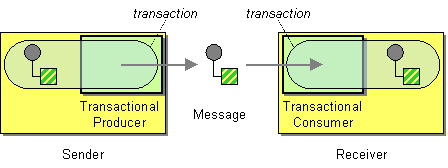
Use a Transactional Client—make the client’s session with the messaging system transactional so that the client can specify transaction boundaries.
Both a sender and a receiver can be transactional. With a sender, the message isn’t “really” added to the channel until the sender commits the transaction. With a receiver, the message isn’t “really” removed from the channel until the receiver commits the transaction. A sender that uses explicit transactions can be used with a receiver that uses implicit transactions, and vise versa. A single channel might have a combination of implicitly and explicitly transactional senders; it could also have a combination of receivers.
...Related patterns: Channel Adapter, Competing Consumers, Document Message, Event-Driven Consumer, Event Message, Guaranteed Delivery, Message, Message Channel, Message Dispatcher, Message Endpoint, Message Router, Message Sequence, Message Translator, Messaging Bridge, Pipes and Filters, Point-to-Point Channel, Polling Consumer, Publish-Subscribe Channel, Request-Reply, Resequencer

For a full description of the pattern see:
 | Enterprise Integration Patterns
Gregor Hohpe and Bobby Woolf ISBN 0321200683 650 pages Addison-Wesley |
| Home • Patterns • Table of Contents |  Previous Next Previous Next  |
 | © 2003 • Bobby Woolf • All rights reserved. |