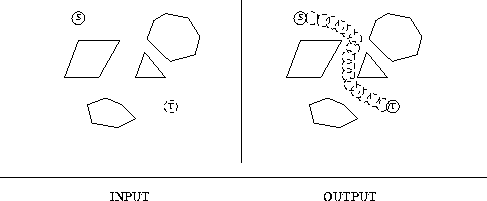

Input description: A polygonal-shaped robot in a given starting position in a room containing polygonal obstacles, with a desired ending position t.
Problem description: Find the shortest path in the room taking to t without intersecting any of the obstacles.
Discussion: The difficulty of motion planning will be obvious to anyone who has ever had to move a large piece of furniture into a small apartment. The problem of motion planning also arises in systems for molecular docking. Many drugs are small molecules that act by binding to a given target model. The problem of identifying which binding sites are accessible to a candidate drug is clearly an instance of motion planning. Plotting paths for mobile robots is another canonical motion-planning application.
Motion planning also provides a tool for computer animation.
Given a set of object models that appear in two different scenes  and
and
 , a
motion planning algorithm can construct a short sequence of intermediate
motions to transform
to .
These motions can serve to fill in the intermediate scenes between
and , with such scene interpolation greatly
reducing the amount of work the animator has to do.
, a
motion planning algorithm can construct a short sequence of intermediate
motions to transform
to .
These motions can serve to fill in the intermediate scenes between
and , with such scene interpolation greatly
reducing the amount of work the animator has to do.
There is a wide range in the complexity of motion planning problems, with many factors to consider:
A brute-force algorithm to construct the visibility graph tests each candidate
edge against the  obstacle edges for a total time of
  time.
By weighting each edge of the visibility graph with its length and
using Dijkstra's shortest-path algorithm (see Section
time.
By weighting each edge of the visibility graph with its length and
using Dijkstra's shortest-path algorithm (see Section  )
on this graph, we can find the shortest path from to t in time bounded
by the time to construct the graph.
)
on this graph, we can find the shortest path from to t in time bounded
by the time to construct the graph.
).
This creates a larger obstacle, defined as
the robot walks a loop around the obstacle while maintaining contact with it.
Finding a path from the initial position of the reference point to the goal
point amidst these fattened obstacles defines a legal path for
the polygonal robot.
The most practical approach to motion planning involves randomly sampling
the configuration space of the robot.
The configuration space defines the set of legal positions for the robot
and has one dimension for each degree of freedom.
For a planar robot capable of translation and rotation,
the degrees of freedom are the x- and y-coordinates of a
reference point on the robot
and the angle  relative to this point.
Certain points in this space represent legal positions, while others intersect
obstacles.
relative to this point.
Certain points in this space represent legal positions, while others intersect
obstacles.
Construct a set of legal configuration-space points by random sampling.
For each pair of points  and
and  , decide whether there exists
a direct, nonintersecting path between them.
Construct a graph with vertices for each legal point and edges for
each such traversable pair.
The problem of finding a motion between two arbitrary positions reduces
to seeing if there is a direct path from the initial/final position to
some vertex in the graph, and then solving a shortest-path problem in the
graph.
, decide whether there exists
a direct, nonintersecting path between them.
Construct a graph with vertices for each legal point and edges for
each such traversable pair.
The problem of finding a motion between two arbitrary positions reduces
to seeing if there is a direct path from the initial/final position to
some vertex in the graph, and then solving a shortest-path problem in the
graph.
There are lots of ways to enhance this basic technique for specific applications, such as adding additional vertices to regions of particular interest. This is a nice, clean approach for solving problems that would get very messy otherwise.
Implementations: An implementation of collision detection (not really motion planning)
is the I_COLLIDE collision detection library.
For more information, check out the I_COLLIDE WWW page:
http://www.cs.unc.edu/  geom/I_COLLIDE.html.
O'Rourke [O'R94] gives a toy implementation of an algorithm
to plot motion for a two-jointed robot arm in the plane.
See Section .
Notes: Motion planning was originally studied by Schwartz and Sharir
as the ``piano mover's problem.''
Their solution constructs the complete free space of robot positions
which do not intersect obstacles, and then finds the shortest path
within the proper connected component.
These free space descriptions are very complicated, involving
arrangements of higher-degree algebraic surfaces.
The fundamental papers on the piano mover's problem appear in [HSS87],
with [SS90] being a survey of current results.
The best general result for this free space approach to motion planning
is due to Canny [Can87], who showed that any problem with d
degrees of freedom can be solved in  , although faster algorithms
exist for special cases of the general motion planning problem.
, although faster algorithms
exist for special cases of the general motion planning problem.
Latombe's book [Lat91] describes practical approaches to motion planning, including the random sampling method described above. The expanded obstacle approach to motion planning is due to Lozano-Perez and Wesley [LPW79]. The heuristic, sightless man's approach to motion planning discussed above has been studied by Lumelski [LS87].
The time complexity of algorithms based on the free-space approach to
motion planning depends intimately on the combinatorial complexity of the
arrangement of surfaces defining the free space.
Algorithms for maintaining arrangements are presented in
Section .
Davenport-Schintzl sequences often arise in the analysis of such arrangements.
Sharir and Agarwal [SA95] provide a comprehensive treatment of
Davenport-Schintzl sequences and their relevance to motion planning.
Kedem and Sharir [KS90] give an  time algorithm to find
a path (not necessarily shortest) to translate a convex k-gon from
to t.
Vegter [Veg90] gives an optimal
time algorithm to find
a path (not necessarily shortest) to translate a convex k-gon from
to t.
Vegter [Veg90] gives an optimal  algorithm
for moving a line segment (often called a ladder) in the plane with
both translation and rotation.
algorithm
for moving a line segment (often called a ladder) in the plane with
both translation and rotation.
Related Problems: Shortest path (see page ),
Minkowski sum (see page ).